18 Baby Side Profile Tattoo Ideas That Capture Pure Love
There’s a version of your baby that only existed for a few weeks. The one before the hair grew in, before the face changed shape, before the world got its hands on them. A side profile tattoo is how a lot of parents choose to keep that exact version close.
This isn’t just a gallery of pretty silhouettes. Below you’ll find the actual mechanics, how to take a photo your artist can actually work with, why size matters more than most people realize, and eighteen ways to make the design unmistakably yours. Bring it into your consult and skip the guesswork.

Choosing Your Style at a Glance
| Tattoo Style | Detail Level | Longevity | Best Body Placement |
|---|---|---|---|
| Single Line | Low | Excellent, least prone to blur | Wrist / Behind Ear |
| Silhouette | Medium | Very Good | Inner Forearm / Upper Arm |
| Floral | Medium to High | Good, needs 3+ inch scale | Rib Line / Shoulder |
| Realism | High | Moderate, needs earlier touch-ups | Upper Arm / Shoulder Blade |
📸 How to Take the Reference Photo
Before your artist can trace a single line, they need a photo that actually shows what they’re working with. Most parents don’t realize how much the reference shot matters until the stencil comes back looking off.
The 90-Degree Ear-Level Angle: Hold the camera exactly level with your baby’s ear, straight from the side. Even a slight tilt up or down flattens the nose and lips, the two features that actually make a profile look like your baby.
The Sleeping Baby Hack: Wait until nap time and get in close. A sleeping baby holds still long enough for a sharp shot, and closed eyes let those long newborn eyelashes show up naturally instead of getting lost mid-blink.
High Contrast / Backlight: Shoot against a plain white wall or with soft window light behind your baby. The stronger the contrast between silhouette and background, the easier it is for your artist to trace a clean outline instead of guessing where the edge falls.
⚠️ Before You Commit: The Fine-Line Aging Reality
The biggest fear with any fine-line tattoo isn’t regret, it’s watching it blur. Baby profile tattoos are especially vulnerable since the whole design lives in delicate detail. Two things determine whether yours stays sharp.
Minimum 2.5 to 3 Inch Scale Rule: Anything smaller than about an inch tends to spread and soften within three to five years as ink naturally migrates under the skin. Keeping the profile at least 2.5 to 3 inches gives the linework enough room to age gracefully.
Needle Choice Matters: Ask your artist about single needle versus a tight 3RL grouping. A tight grouping holds a cleaner line over time than an overly thin single-needle pass, especially on a design this detail-dependent.
18 Baby Side Profile Tattoo Ideas
1. Classic Black Ink Baby Profile
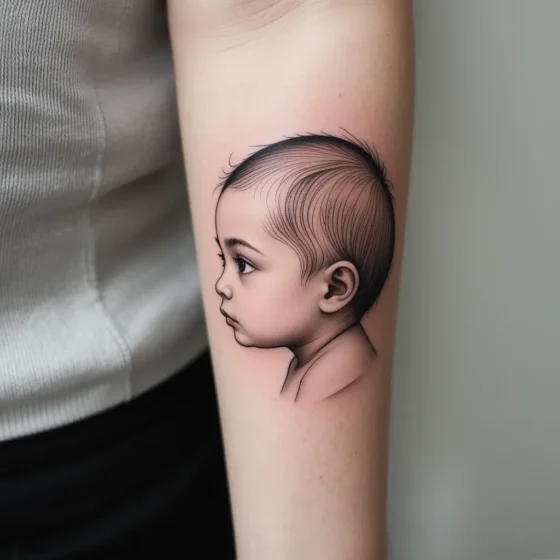
Clean and timeless, this is the version most parents picture first when they imagine a baby silhouette tattoo.
The Design Vibe: Solid black fill with one continuous, confident outline. No shading, no fuss, just the shape of your baby’s face in a single clean line.
Custom Add-on Tip: Add a thin single-line halo or a tiny star just above the head for warmth without breaking the simplicity.
Placement & Aging Tip: Inner forearm or wrist. Solid black fill holds its edge well and rarely needs a touch-up before the ten year mark.
2. Minimalist Line Art Profile
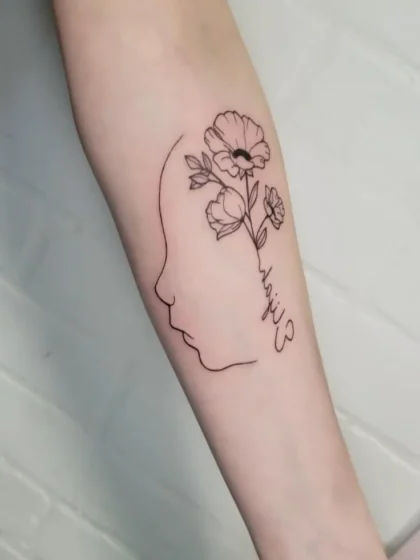
A soft, unfilled outline that lets the negative space do most of the emotional work.
The Design Vibe: Dainty fine-line work, a single continuous stroke, no fill at all. The quietest, most understated version on this list.
Custom Add-on Tip: Pair it with our fineline tattoo ideas for matching small details elsewhere, a tiny heart, a single dot for a birthstone.
Placement & Aging Tip: Wrist or behind the ear. With no solid fill to blur, this style ages well, provided the size stays above the 2.5 inch minimum.
3. Realistic Portrait Profile

For parents who want something closer to a photograph than a symbol, this version leans fully into detail.
The Design Vibe: Fine shading builds out the curve of the cheek, the shape of the ear, even faint eyelashes, closer to a charcoal sketch than a simple outline.
Custom Add-on Tip: Add a soft gradient background in warm skin tones for extra depth without introducing a second color palette.
Placement & Aging Tip: Upper arm or shoulder blade. The shading needs real space to hold up over decades, so this isn’t one to shrink down small.
4. Baby Profile with Name Script
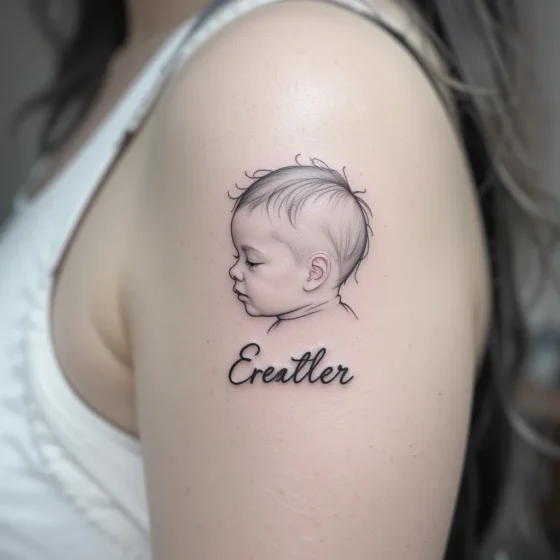
The silhouette carries the emotion, and the name underneath makes it unmistakably theirs.
The Design Vibe: A clean profile paired with cursive or serif lettering, usually sitting just beneath the chin or curved along the jawline.
Custom Add-on Tip: Match the script’s weight to the profile’s outline thickness so neither element visually outweighs the other.
Placement & Aging Tip: Inner forearm gives the script enough length to stay legible. Avoid the ribcage, since curved lettering on a high-movement area distorts first.
5. Profile with Birth Date
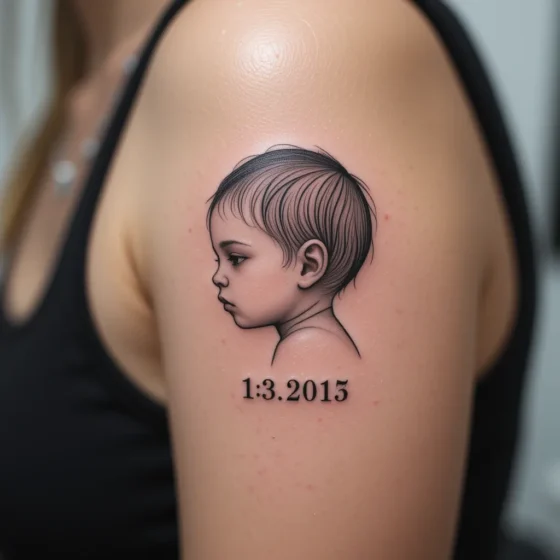
A quiet way to freeze the exact moment your child arrived, tucked right alongside their profile.
The Design Vibe: Roman numerals or a simple numeric date in delicate serif font, usually placed in a small arc beneath the silhouette.
Custom Add-on Tip: Use Roman numerals along the collarbone or a slim rib line for an elegant, almost engraved look.
Placement & Aging Tip: Collarbone holds fine numerals well since the skin stays relatively flat. Confirm needle choice so the tiny characters don’t bleed together as the tattoo settles.
6. Watercolor Background Profile
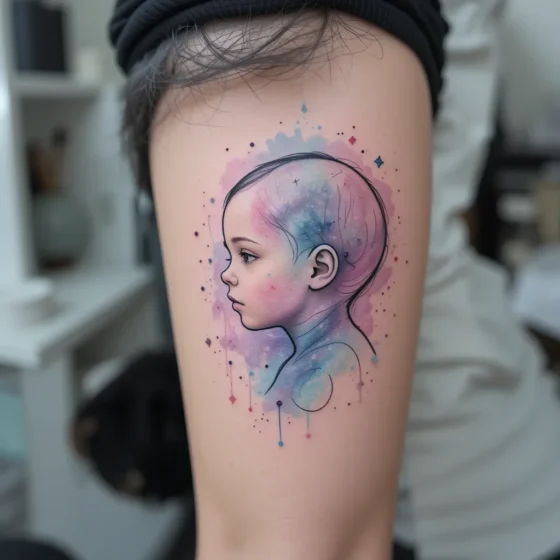
The profile itself stays crisp while a soft wash of color blooms around it like a memory caught mid-fade.
The Design Vibe: Black linework silhouette layered over loose pastel washes, usually blush pink, lavender, or soft sky blue.
Custom Add-on Tip: Keep the watercolor portion small and secondary. Let it frame the profile rather than compete with it.
Placement & Aging Tip: Upper arm or shoulder. Watercolor pigment spreads faster than black ink, so plan on a touch-up sooner, often within five to seven years.
7. Baby Profile Inside a Heart Outline
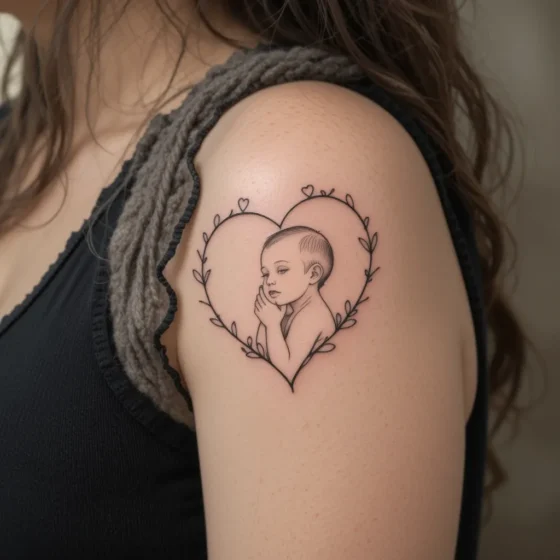
A simple frame that says exactly what the tattoo already means, this one just says it a little louder.
The Design Vibe: A single-line heart wrapped around the profile, keeping both elements light so neither feels crowded.
Custom Add-on Tip: Leave a small gap in the heart’s outline where the forehead meets the edge, a subtle detail that keeps the design from feeling too stiff.
Placement & Aging Tip: Wrist or ankle. Keep the heart slightly larger than you think you need, since thin single lines blur first if the piece runs too small.
8. Profile with Angel Wings
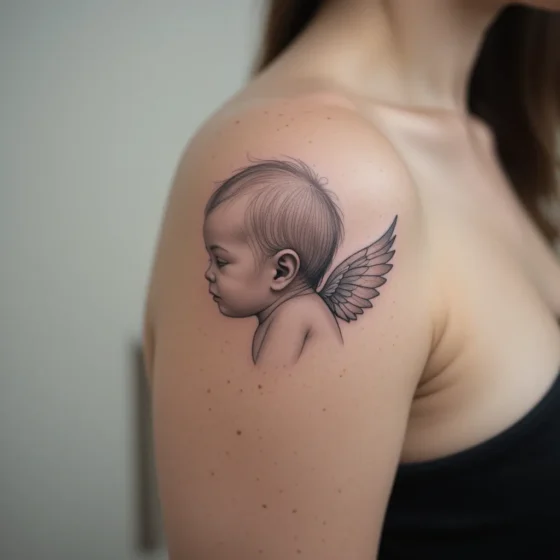
For families honoring a baby lost too soon, or simply leaning into a spiritual read on new life, wings change the whole tone of the piece.
The Design Vibe: Delicate feathered wings extending from the back of the profile, usually rendered in the same fine linework as the silhouette itself.
Custom Add-on Tip: Our angel wings tattoo ideas cover feather detailing and shading that pairs beautifully with a profile like this.
Placement & Aging Tip: Shoulder blade or upper back gives the wingspan room to extend fully without cramping the profile.
9. Floral Frame Profile Tattoo
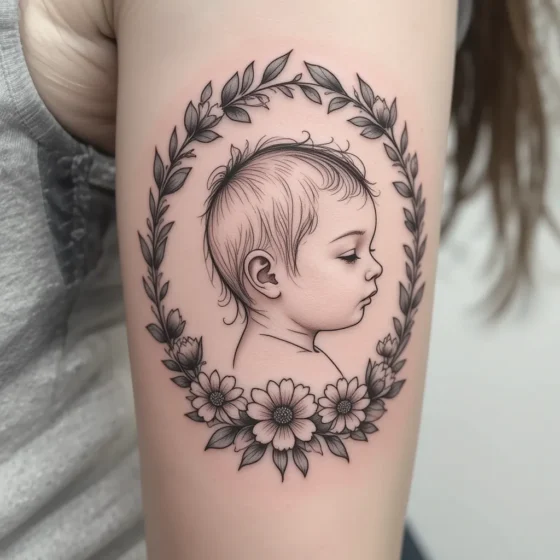
Flowers turn the profile into something that feels grown rather than just drawn, soft and a little wild around the edges.
The Design Vibe: A loose wreath or half-frame of small blooms circling the silhouette, in fine line or lightly shaded illustrative style.
Custom Add-on Tip: Swap generic flowers for your baby’s actual birth month flower, violet for February, daisy for April, rose for June, so the frame carries hidden meaning. Our daisy tattoo ideas are worth a look if April is the month you’re working with.
Placement & Aging Tip: Upper rib line or shoulder. Keep the florals loosely spaced, since dense fine-line clusters are more prone to blurring together over time.
10. Silhouette with Soundwave

A literal record of the first sound your baby made, or the rhythm of their heartbeat, worked directly into the design.
The Design Vibe: A thin waveform line that trails into or out of the profile’s outline, turning sound into shape.
Custom Add-on Tip: Line the waveform’s peak up with the crown of the baby’s head, so the heartbeat visually flows straight into the silhouette instead of sitting beside it.
Placement & Aging Tip: Inner forearm gives the waveform enough straight length to stay readable. Don’t go below the 2.5 inch minimum or the peaks and dips blur into a flat line.
11. Parent and Baby Profile Together
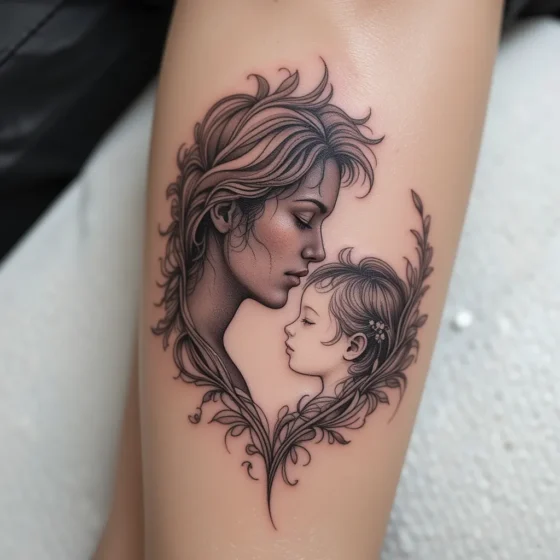
Two profiles facing each other says more about the relationship than either silhouette could say alone.
The Design Vibe: An adult profile and a baby profile positioned nose to nose, often connected by a small gap of negative space that reads like a held breath.
Custom Add-on Tip: For a tender variation, have the two profiles touching foreheads directly rather than facing at a distance. It reads as more intimate and works especially well as a mother-baby piece.
Placement & Aging Tip: Upper arm or back of shoulder keeps both profiles proportional. Ribcage works too, but expect more stretching risk if more pregnancies are ahead.
12. Profile with Birth Coordinates
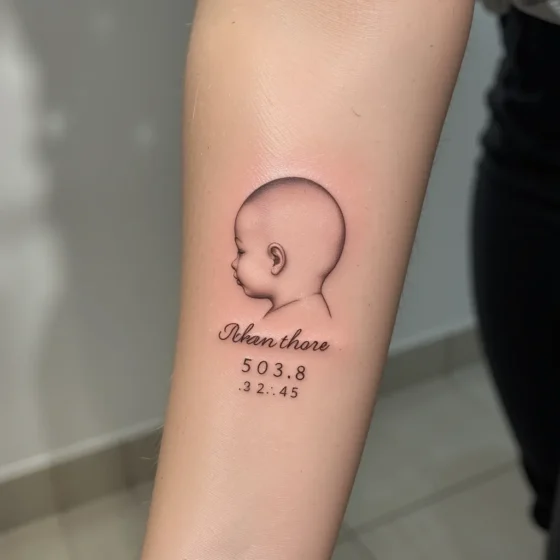
The exact spot on the map where your child entered the world, held permanently alongside their profile.
The Design Vibe: Small numeric coordinates in a delicate serif or typewriter-style font, arced beneath or beside the silhouette.
Custom Add-on Tip: Collarbone or rib line placements let the coordinates run in a straight, level line, which keeps the numbers from warping over a curved muscle.
Placement & Aging Tip: Confirm your artist is using a tight needle grouping. Loose linework here is the fastest way for tiny numbers to blur into illegibility.
13. Newborn Profile with Footprint
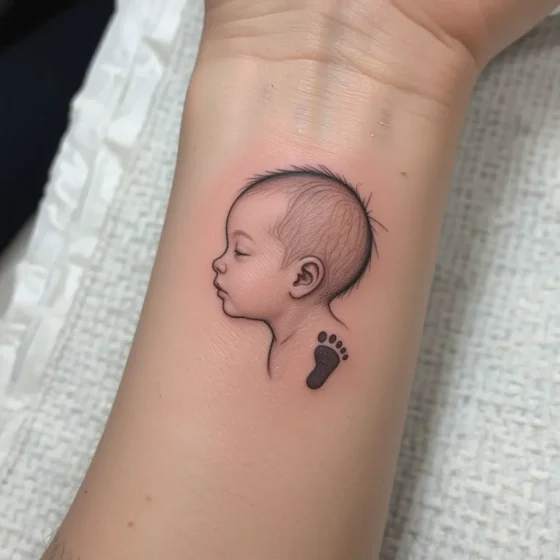
Pairing the profile with an actual tiny footprint turns the tattoo into something closer to a keepsake than a design.
The Design Vibe: A fine-line profile alongside a small, proportionally accurate footprint, sometimes traced directly from a real newborn footprint on file.
Custom Add-on Tip: Ask your artist to size the footprint true to scale from a real print rather than a generic template, a small detail that makes the piece feel like a document, not decoration.
Placement & Aging Tip: Ankle or wrist. Keep the footprint close to actual newborn size rather than shrinking it further to fit a smaller space.
14. Crescent Moon and Baby Profile
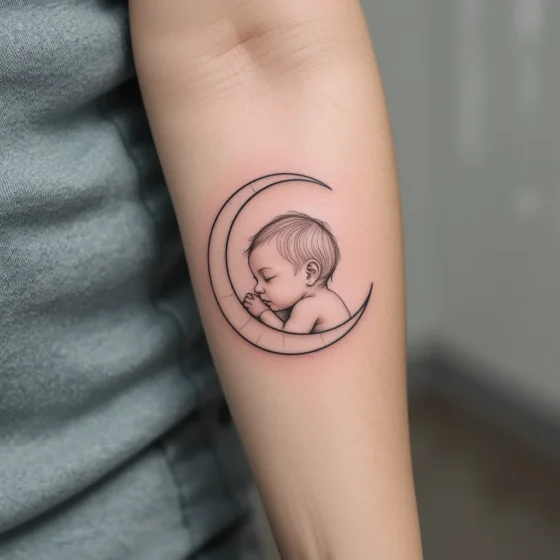
Nestling the profile inside a crescent moon gives the whole piece a hushed, bedtime kind of stillness.
The Design Vibe: A thin crescent moon outline cradling the baby’s silhouette, sometimes with a few small stars scattered around it. Our mandala wrist tattoo ideas share this same celestial, symbol-heavy sensibility if you want to build the theme out further.
Custom Add-on Tip: Angle the moon so its points cradle the chin and forehead, making the two shapes feel like one continuous design rather than two overlapping ones.
Placement & Aging Tip: Wrist or upper arm. Avoid placing this over a joint that bends constantly, like the inside of the elbow, since the crescent’s points are delicate linework.
15. Baby Profile with Stars or Constellations

Scatter a few stars around the silhouette and the whole tattoo starts to feel like a small piece of sky.
The Design Vibe: Fine dot-and-line stars or an actual zodiac constellation worked in around the profile’s outline, kept light so the stars read as accents.
Custom Add-on Tip: Use your baby’s actual birth month zodiac constellation rather than generic stars, a detail most people won’t clock at a glance but that means everything to you.
Placement & Aging Tip: Shoulder or upper back gives the scattered stars room to breathe. Keep individual stars small but not microscopic, tiny dots disappear first as fine-line work settles.
16. Side Profile in Frame or Cameo Style
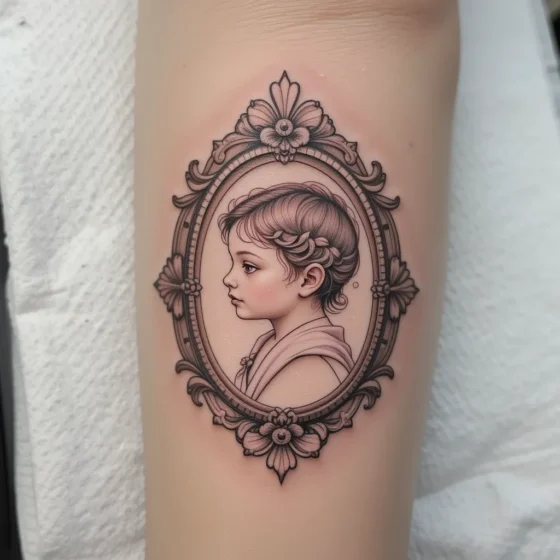
An ornate border turns the profile into something that looks like it was passed down rather than just inked.
The Design Vibe: A vintage oval or cameo-style frame surrounding the silhouette, often with scrollwork or a beaded edge. Our lace tattoo ideas pair naturally with this same vintage, ornamental mood.
Custom Add-on Tip: Keep the frame’s detail slightly heavier than the profile’s linework so the border reads clearly as a frame rather than competing for attention.
Placement & Aging Tip: Upper arm or shoulder blade. The scrollwork needs real size to stay legible, this isn’t a design that holds up well much below three inches.
17. Twin Baby Profiles
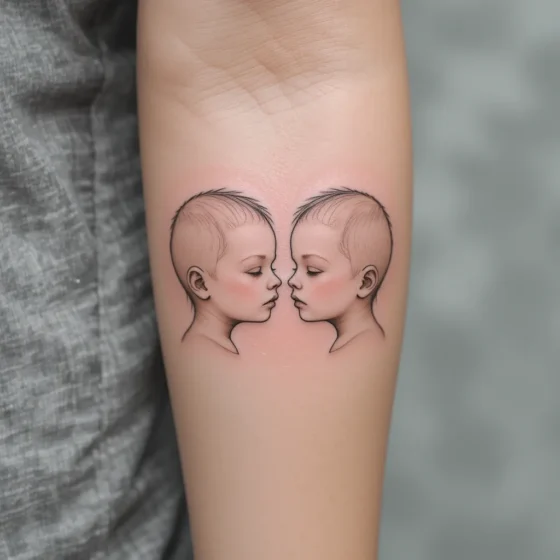
Two silhouettes, mirrored or side by side, for the parents who got double the news and double the love.
The Design Vibe: Matching profiles rendered identically in style and scale, either facing the same direction or mirrored toward each other for symmetry.
Custom Add-on Tip: Give each profile a tiny individual marker, a birthstone dot, a different flower, so the design honors both children as individuals.
Placement & Aging Tip: Upper back or shoulder blade gives both profiles equal, symmetrical space, with enough gap that a future touch-up on one side won’t affect the other.
18. Profile with “Mama” or “Papa” Script
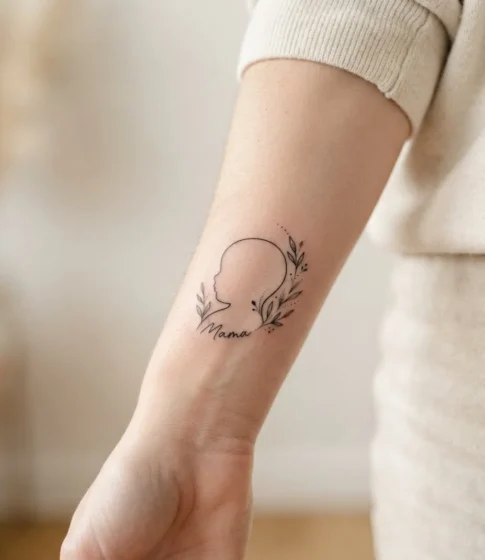
A short, direct word that turns the tattoo from a tribute to your child into a statement about who you’ve become.
The Design Vibe: The silhouette paired with a single word in delicate script, usually curved just below the chin or along the base of the design.
Custom Add-on Tip: Keep the lettering small enough to feel like a whisper rather than a headline. The profile should still be the first thing anyone notices.
Placement & Aging Tip: Wrist or inner forearm keeps the short word legible without needing much length. Avoid heavy natural creasing, like the inner wrist crease, where fine script distorts fastest.
Placement & Pain Guide
| Body Placement | Pain Level (1–5) | Visibility | Stretching Risk | Approx Cost ($) |
|---|---|---|---|---|
| Inner Forearm | 2 / 5 (Low) | High, daily visible | Very Low | $80–$180 |
| Collarbone / Upper Chest | 3.5 / 5 (Moderate) | Medium | Low | $100–$220 |
| Ribcage / Side | 4.5 / 5 (High) | Private | Medium, weight changes | $120–$250 |
| Above Ankle / Calf | 2.5 / 5 (Low-Mod) | Medium | Low | $80–$160 |
| Back of Arm (Tricep) | 2 / 5 (Low) | Subtle | Very Low | $90–$200 |
Final Thoughts
Eighteen ideas, one shared purpose: holding onto a version of your child that’s already gone the moment it happens.
Whether you keep it as simple as a single black line or build out a full cameo frame with birth flowers and coordinates, the details you choose now are the ones you’ll be glad you got right in twenty years.
Take the photo carefully, size it generously, and bring both tables into your consult so your artist is working from the same page you are.
Frequently Asked Questions
How soon after birth can I get this tattoo?
There’s no medical rule, but many parents wait a few weeks until the baby’s features settle into a more permanent look, since newborn faces change fast in the first month.
Will the tattoo still look like my child as they grow?
Yes, because it’s capturing a moment, not tracking growth. The tattoo freezes exactly how your baby looked at the age of the reference photo, which is the entire point.
Can I add a second child’s profile later?
Definitely. Many parents choose placements like the upper arm specifically to leave room for future siblings’ profiles alongside the first.
Is this tattoo safe to get while breastfeeding?
Most artists and lactation consultants recommend waiting until breastfeeding has ended or is well established, since tattoo ink hasn’t been studied for transfer through breast milk. Talk to your doctor before booking.
What if I don’t have a good side profile photo yet?
Follow the reference photo guide above at your baby’s next nap. A sleeping baby in soft, high contrast light is usually easier to capture than a wiggly, awake one.