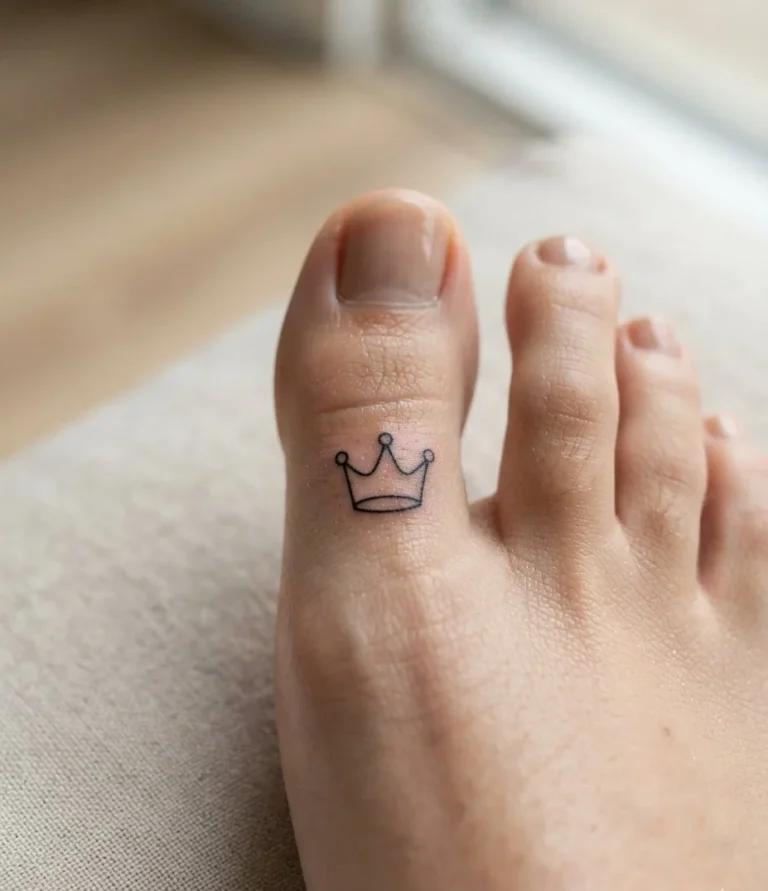
12 Stunning Shoulder Sleeve Tattoos That Flow With Your Body
The shoulder sleeve might be the single most versatile spot in all of body art. It disappears completely under a weekday work shirt, then shows up in full force the second you put on a tank top.
Here’s what catches most first-timers off guard. Your shoulder isn’t flat like a forearm or thigh, it’s a rotating ball of muscle. A stencil that looks perfect while you’re slouched in the tattoo chair can warp and shift the moment you stand up straight, so the design has to flow with your actual deltoid, collarbone, and bicep curves, not just sit on top of them.
This is also where a lot of sleeves go wrong before the first session even starts. Piecing together a handful of disconnected flash designs, a rose here, a skull there, leaves an arm looking cluttered and random. A sleeve that actually reads as intentional needs a unified background filler or deliberate negative-space transitions tying every element together.
Below are 12 of the most saved shoulder sleeve concepts right now, grouped across four aesthetic styles, with exact coverage zones, pain tiers, and session expectations for each one.
Quick Comparison: Coverage & Pain Breakdown
| Coverage Type | Anatomical Boundary | Pain Level | Typical Sessions |
|---|---|---|---|
| Shoulder Cap / Deltoid Only | Rounds the deltoid, stopping above the bicep | 5 / 10 | 1 to 2 |
| Classic Quarter Sleeve | Deltoid down to mid-bicep | 6 / 10 | 2 to 3 |
| Half Sleeve | Shoulder to just above the elbow ditch | 7 / 10 | 3 to 5 |
| Shoulder-to-Chest / Back Wrap | Deltoid extending onto chest or upper back | 8 / 10 | 4 to 6 |
Category 1: Organic & Botanical Motion
1. The Japanese Peony & Wind Bar Wrap
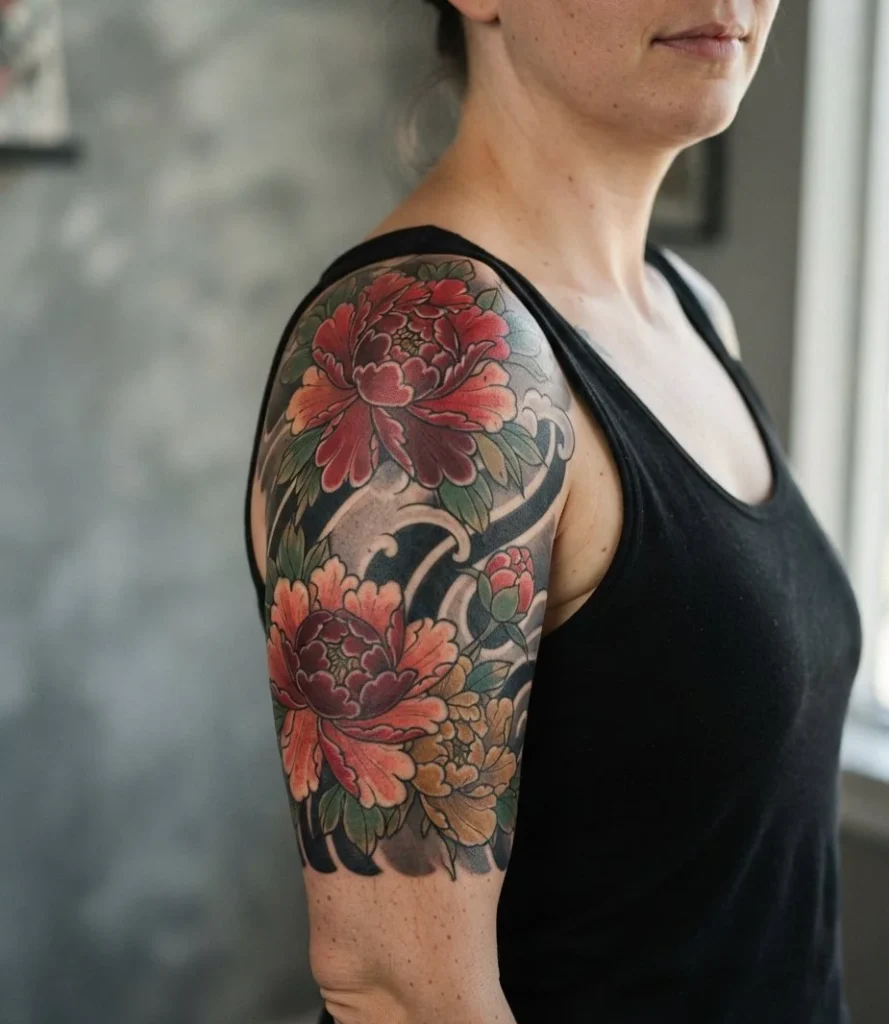
The Visual Concept: Large neo-traditional peony blooms with bold black outlines and wind bar striping curling around the shoulder. Classic Japanese color work in deep reds and golds.
Anatomical Flow & Coverage: The petals follow the deltoid’s natural round shape. Wind bars curve down toward the bicep to guide the eye along the arm’s curve.
Pain & Aging Reality: Moderate pain overall, though the top of the shoulder near the collarbone edge gets sharper. Bold linework and saturated color age well since neo-traditional relies on confident, thick outlines.
Why It Blows Up on Social: Peony sleeves photograph beautifully in motion, the wind bars give even a still photo a sense of movement.
2. Cascading Botanical Ferns & Wild Flora
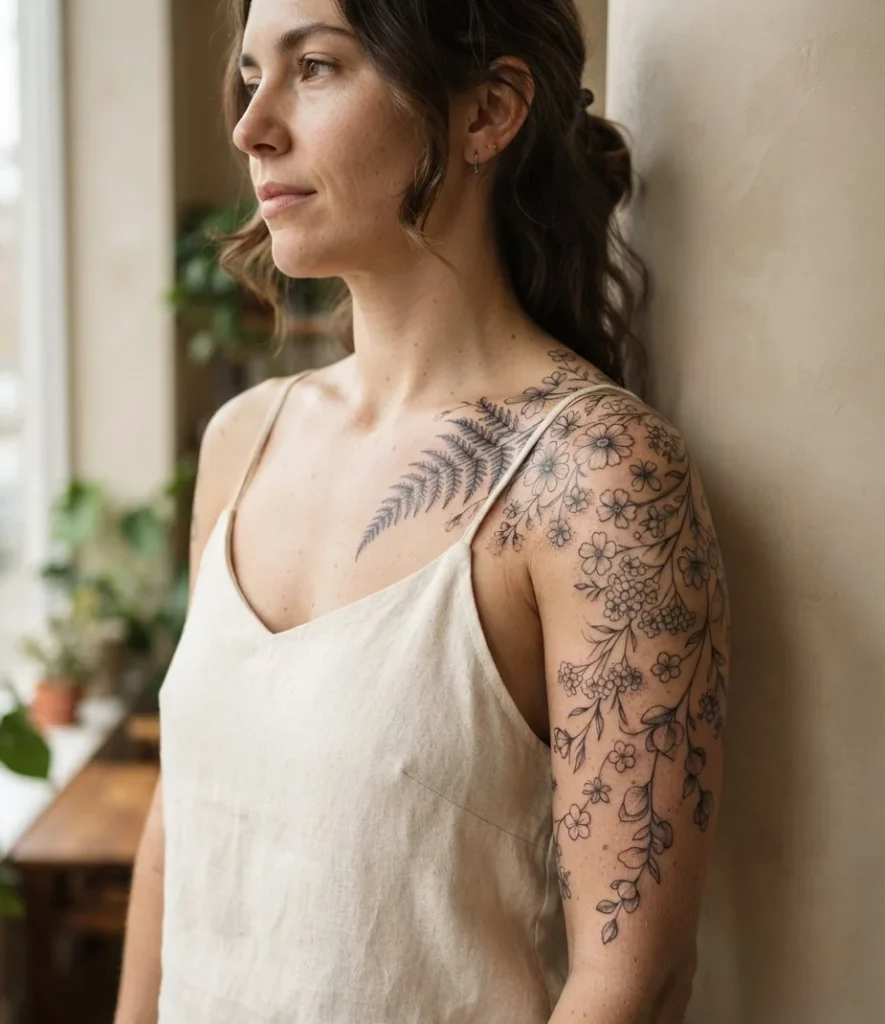
The Visual Concept: Delicate fine-line ferns, wildflowers, and trailing vines spilling down from the collarbone. Soft black linework, minimal shading. Our witchy flower tattoo ideas cover more botanical designs if you want to pull a specific bloom into this same style.
Anatomical Flow & Coverage: Starts narrow near the collarbone and widens over the deltoid, following the natural taper of the shoulder down toward the upper arm.
Pain & Aging Reality: The collarbone edge is noticeably more sensitive than the fleshier deltoid below it. Fine lines need generous spacing or the delicate foliage will blur together within a few years.
Why It Blows Up on Social: It has an effortless, botanical-garden quality that looks equally good in a strapless dress or a gym tank.
3. The Coiling Serpent & Wildflowers
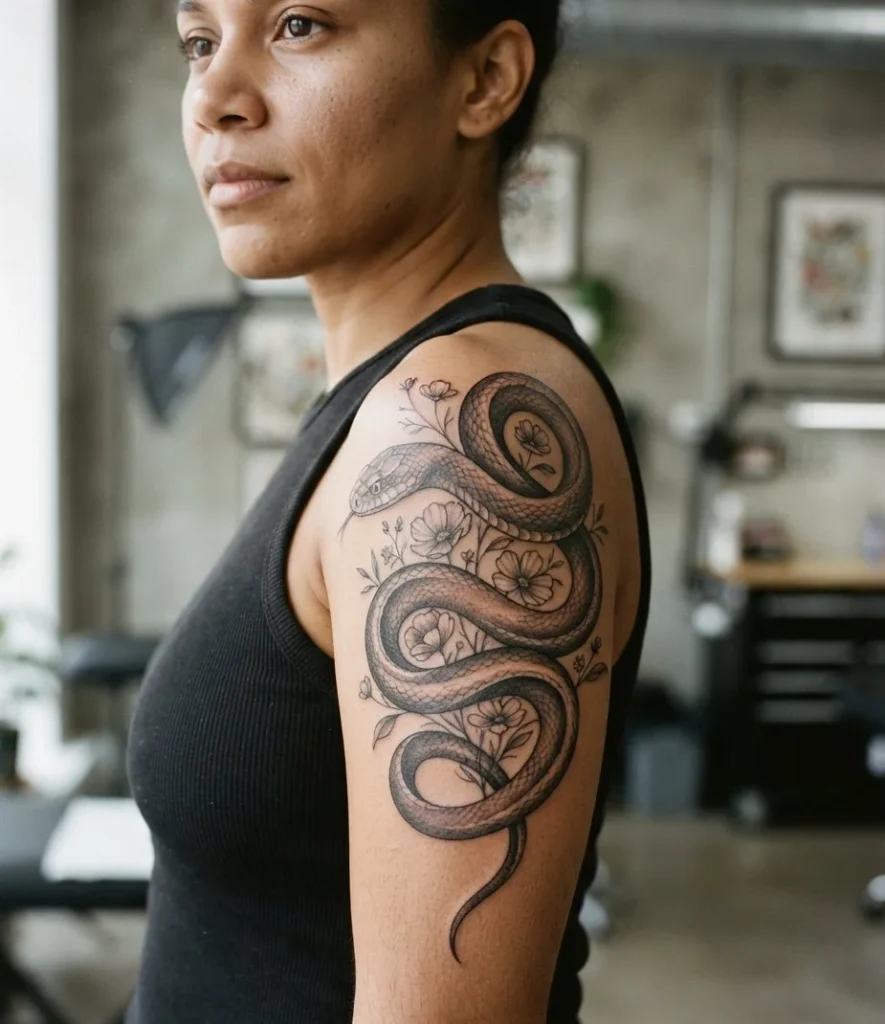
The Visual Concept: A snake coiled in a spiral around the upper arm, wildflowers tucked between the loops, using the arm’s own cylindrical shape as the design’s structure.
Anatomical Flow & Coverage: Wraps fully around the bicep in a continuous spiral starting from the shoulder cap. Genuinely three-dimensional rather than a flat image placed on a curved surface.
Pain & Aging Reality: The inner arm portion of the spiral crosses more sensitive skin than the outer arm. The coil needs to stay visually continuous from every angle, so any shifting is more noticeable here than on a flat panel piece.
Why It Blows Up on Social: Watching the snake “wrap” the whole arm in a slow video pan is exactly the kind of content that performs well.
Category 2: Sacred Geometry & Architectural Structure
4. The Suspended Mandala Deltoid Cap
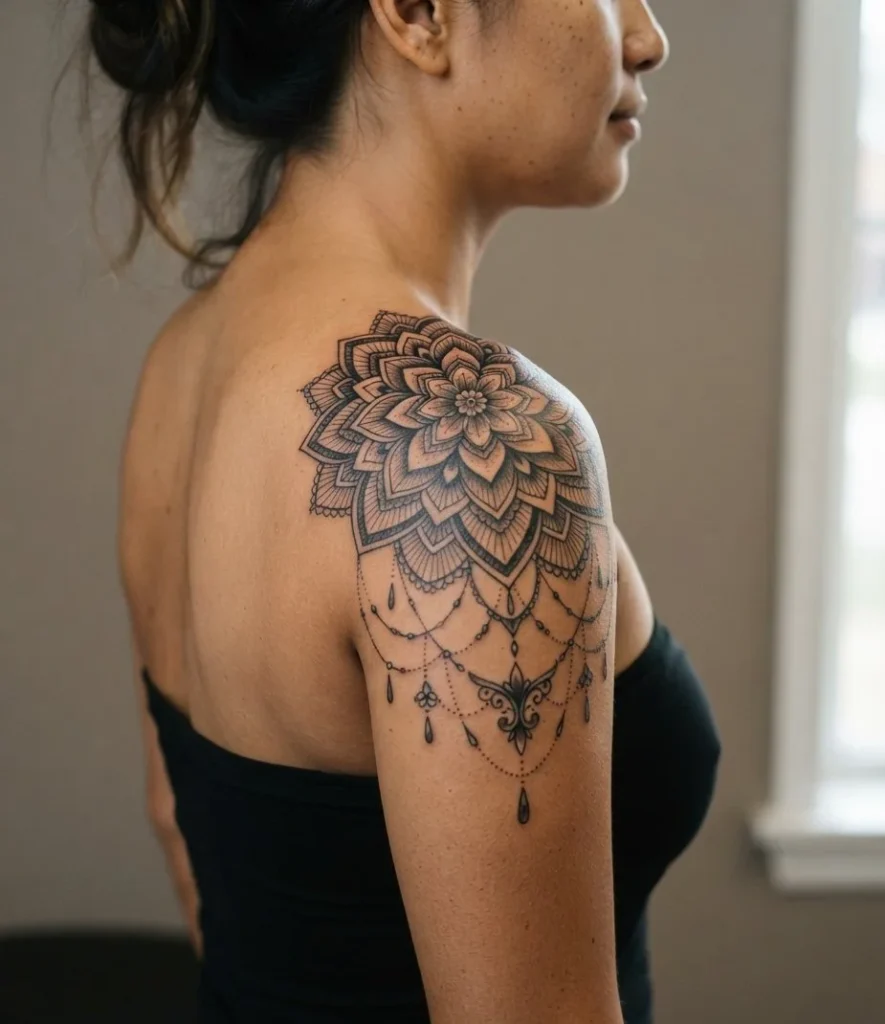
The Visual Concept: A radial mandala centered directly on the deltoid, with lace-like chandelier details trailing downward like dripping jewelry. Our mandala wrist tattoo ideas cover smaller mandala designs if you’d rather keep the geometric piece closer to the hand.
Anatomical Flow & Coverage: The circular symmetry sits squarely on the rounded shoulder cap, using the ball of the deltoid as its natural canvas, while the lace extends toward the bicep.
Pain & Aging Reality: Moderate, fairly even pain across most of the design since it sits mostly on fleshier muscle. The fine radial lines do need real spacing to avoid the symmetry blurring into a soft circle over time.
Why It Blows Up on Social: Mandala work is already a Pinterest staple, and centering it exactly on the shoulder ball gives it a sculptural quality flat placements can’t match.
5. Nordic Vegvisir & Fenrir Knotwork
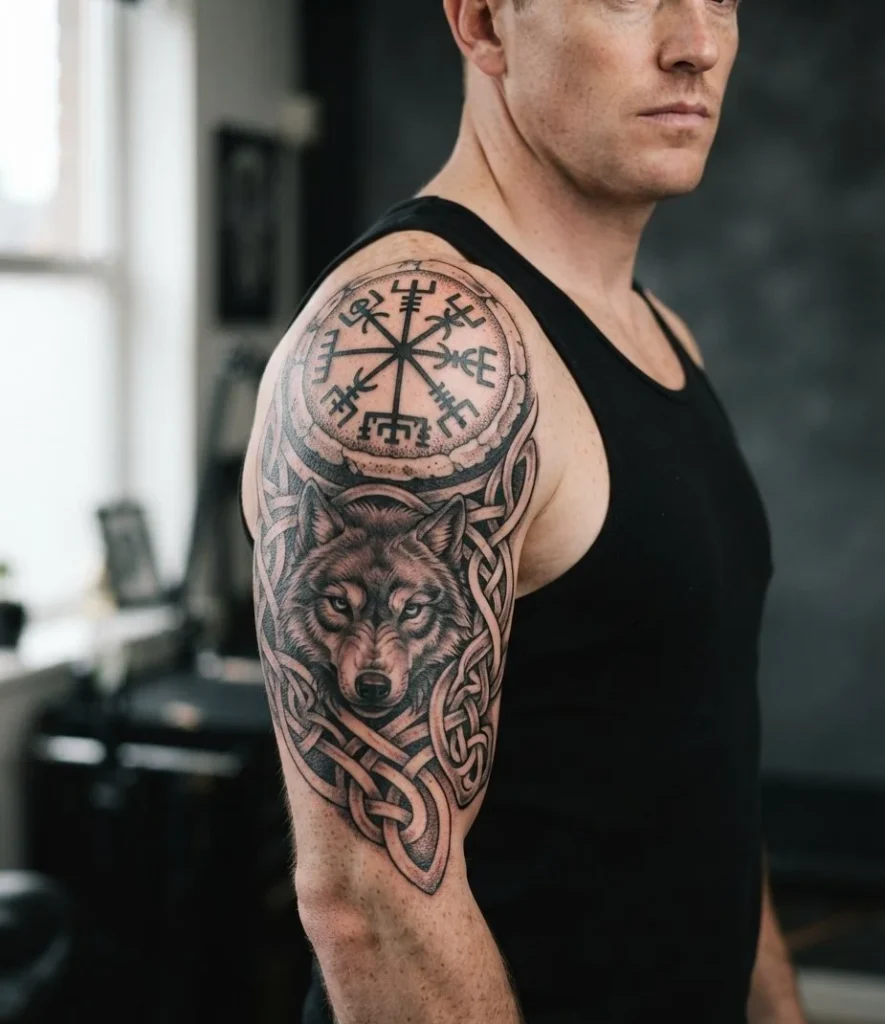
The Visual Concept: A Norse compass symbol paired with Fenrir-inspired knotwork, shaded to look carved into stone rather than drawn with flat lines.
Anatomical Flow & Coverage: The compass sits on the deltoid cap, with knotwork trailing down the outer bicep, using bold blackwork to stay legible against the shoulder’s curve.
Pain & Aging Reality: Solid blackwork sections hold up better than fine detail here. The heavier shading is actually more forgiving over years than delicate linework would be.
Why It Blows Up on Social: Norse and Viking aesthetics have a loyal, highly engaged fanbase that reliably shares and saves this specific style.
6. Baroque Filigree & Sculptural Marble Arches
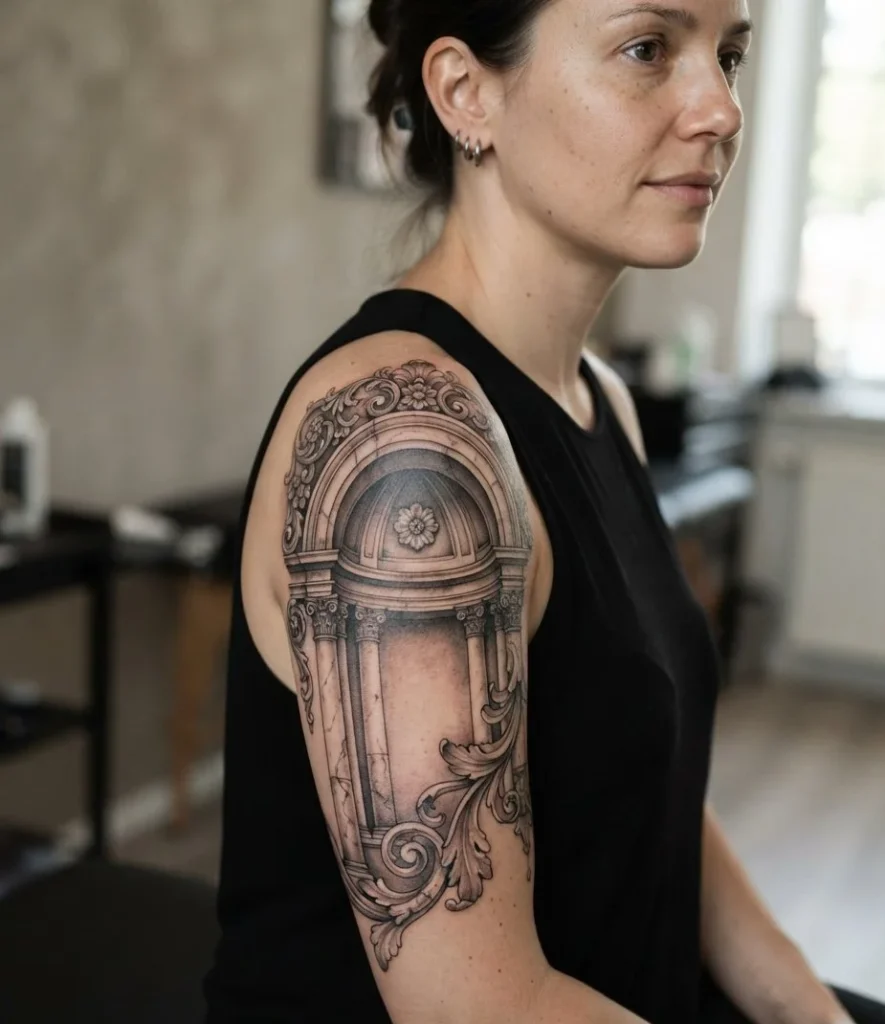
The Visual Concept: Ornate baroque scrollwork and architectural arches with dramatic chiaroscuro shading, like a piece of carved marble framing the shoulder.
Anatomical Flow & Coverage: The arch shapes curve to match the deltoid’s rounded top, with filigree trailing down to frame the bicep like a sculptural border.
Pain & Aging Reality: The heavy shading means longer sessions, but that same shading tends to age gracefully, relying on gradual tonal transitions rather than fine isolated lines.
Why It Blows Up on Social: It reads as fine art rather than flash, the kind of piece that gets mistaken for a photo of an actual sculpture at first glance.
Category 3: Mythological, Cosmic & Celestial Power
7. The Celestial Galaxy & Stardust Drape
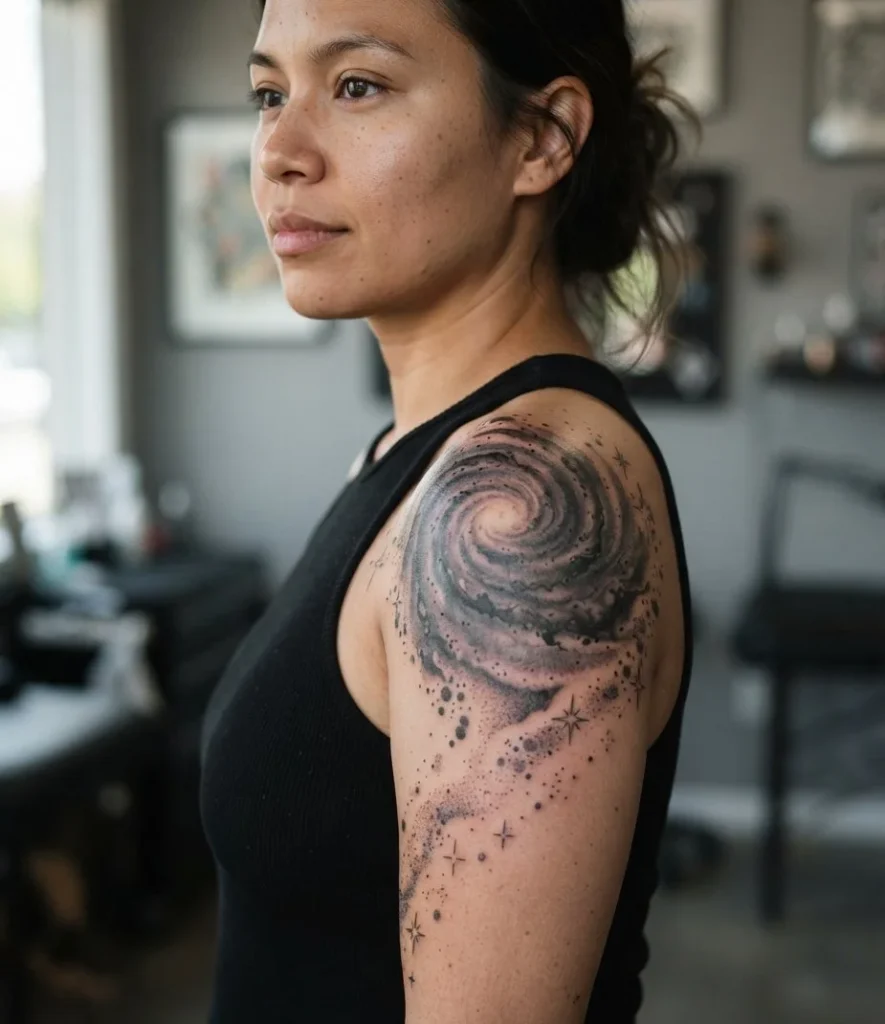
The Visual Concept: A galaxy swirl rendered mostly through negative space and soft shading, stardust gradually dissolving into bare skin toward the inner bicep. Our red moon tattoo ideas cover more celestial designs if you want to build a dedicated moon piece alongside this one.
Anatomical Flow & Coverage: The densest part of the galaxy sits on the deltoid, fading in both color and detail as it wraps down toward the inner arm.
Pain & Aging Reality: The inner bicep edge is more sensitive than the outer deltoid. The gradual fade needs a skilled hand, or it looks patchy once the softest gradient areas settle into skin.
Why It Blows Up on Social: The fade-to-nothing effect is genuinely striking in photos, it looks like the galaxy is emerging from the skin itself.
8. The Greek God Bust & Tempest Waves
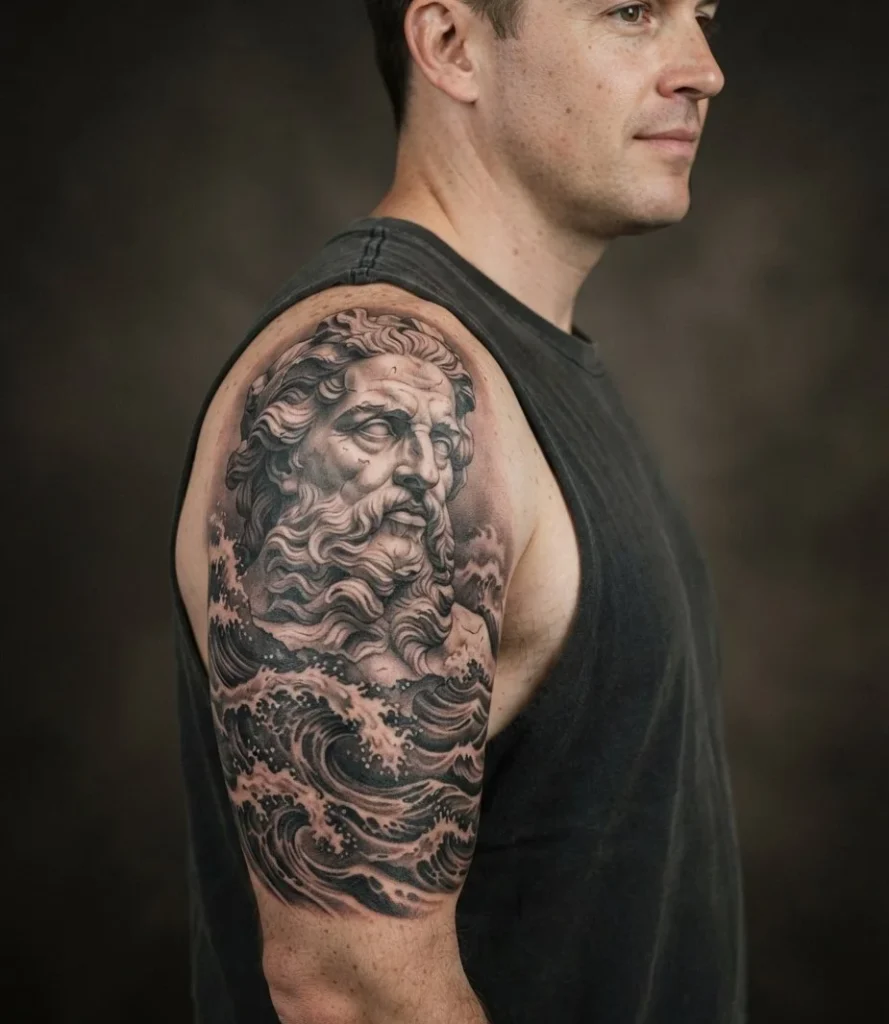
The Visual Concept: A realistic sculptural bust of a Greek god dissolving at the edges into crashing wave linework, blending classical portraiture with ocean motion.
Anatomical Flow & Coverage: The bust centers on the deltoid cap, waves trailing down and around the bicep, using the arm’s curve to suggest the water is moving around it.
Pain & Aging Reality: Realism this detailed needs real session time. Fine facial features require careful spacing to avoid losing definition as the piece ages.
Why It Blows Up on Social: Greek mythology realism is a highly technical style that collectors specifically seek out and share to show off their artist’s skill level.
9. The Rising Phoenix with Feather Sweep
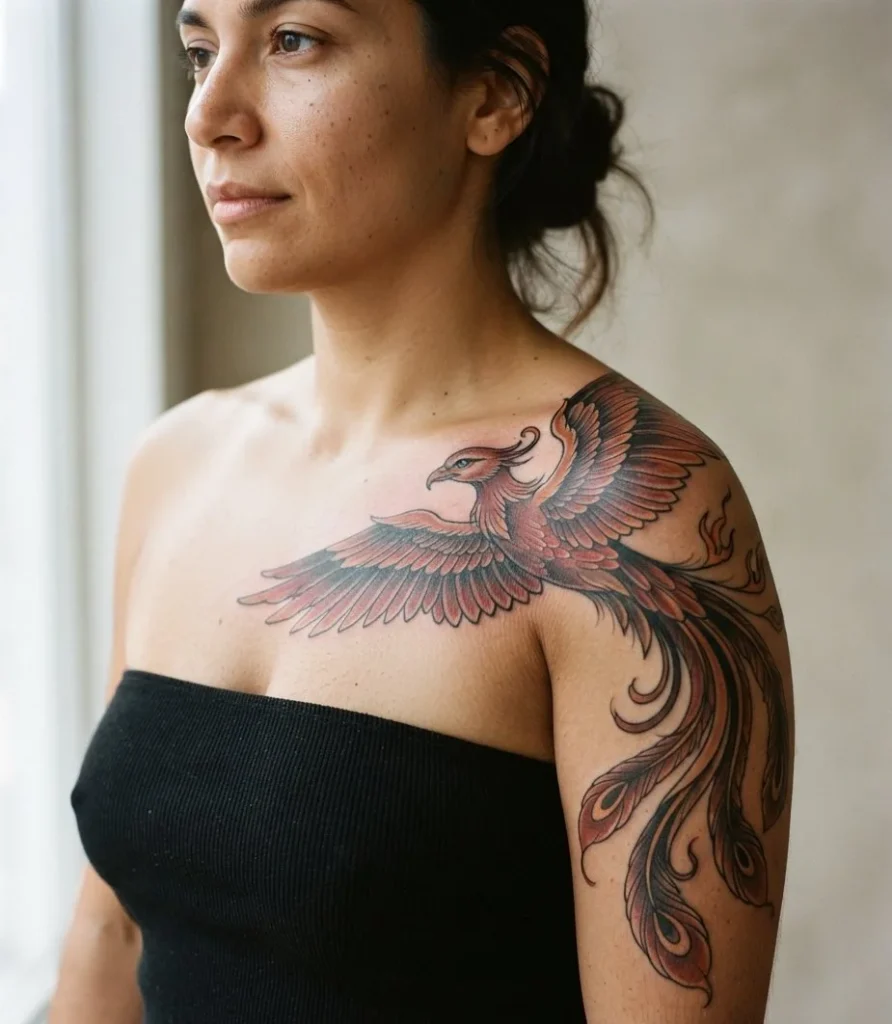
The Visual Concept: A phoenix with wings sweeping upward, feathers trailing from the chest across the collarbone and over the shoulder cap in one continuous motion.
Anatomical Flow & Coverage: Follows the collarbone’s natural line before wrapping up and over the deltoid, using that bone structure as a built-in guide for the wing’s sweep.
Pain & Aging Reality: The collarbone section is genuinely one of the more painful parts of this entire list, thin skin directly over bone. Budget for a slower pace through that section rather than pushing through it in one sitting.
Why It Blows Up on Social: Phoenix imagery already carries huge built-in search volume, and the chest-to-shoulder wrap gives it a dramatic, editorial scale most phoenix tattoos don’t attempt.
Category 4: Illustrative Surrealism & Dark Aesthetic
10. The Vintage Chronometer & Perched Raven
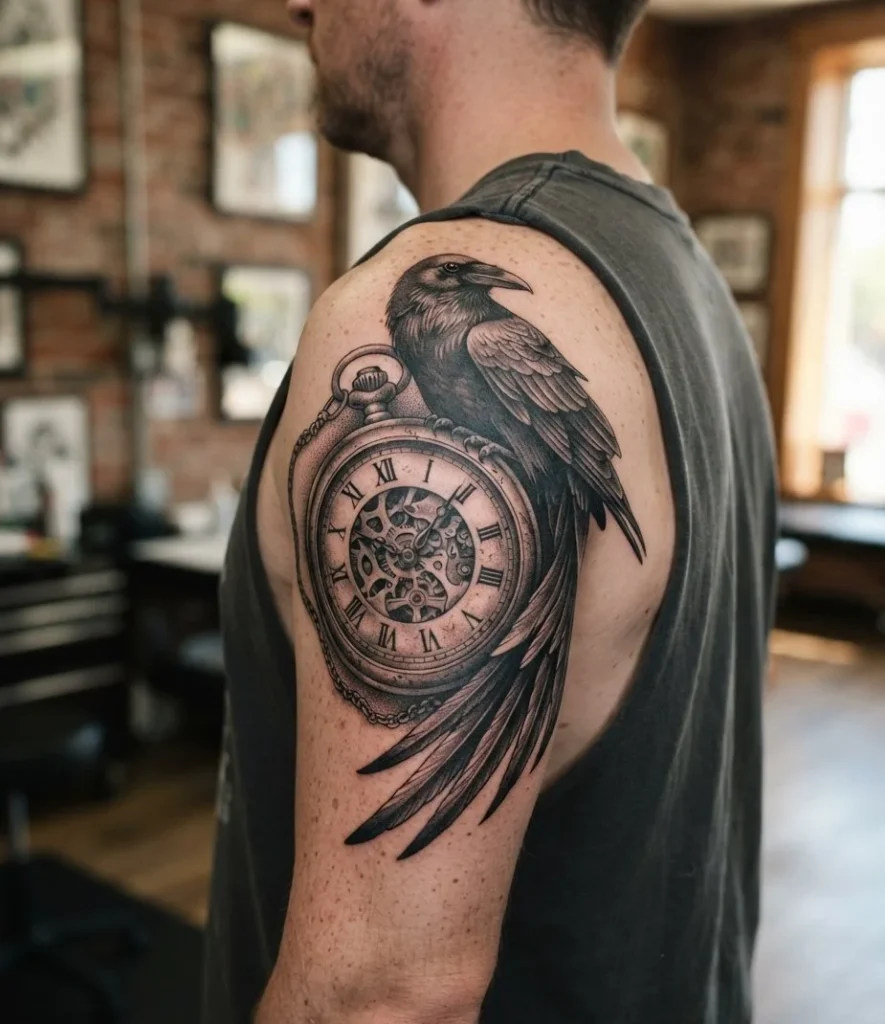
The Visual Concept: An ornate pocket-watch-style chronometer with visible gears and Roman numerals, a raven perched on top with dark feathers trailing around the tricep.
Anatomical Flow & Coverage: The chronometer anchors the deltoid cap, while the raven’s wing feathers wrap around toward the back of the arm, covering the tricep in a way flat forearm placements can’t replicate.
Pain & Aging Reality: The back of the arm, where the tricep wrap happens, tends to be more tolerable than the front, a reasonably approachable pain tier for a detailed piece.
Why It Blows Up on Social: The vintage clockwork aesthetic has a dedicated steampunk and dark-academia audience that actively seeks out exactly this kind of design.
11. Negative Space Tiger in Dense Foliage
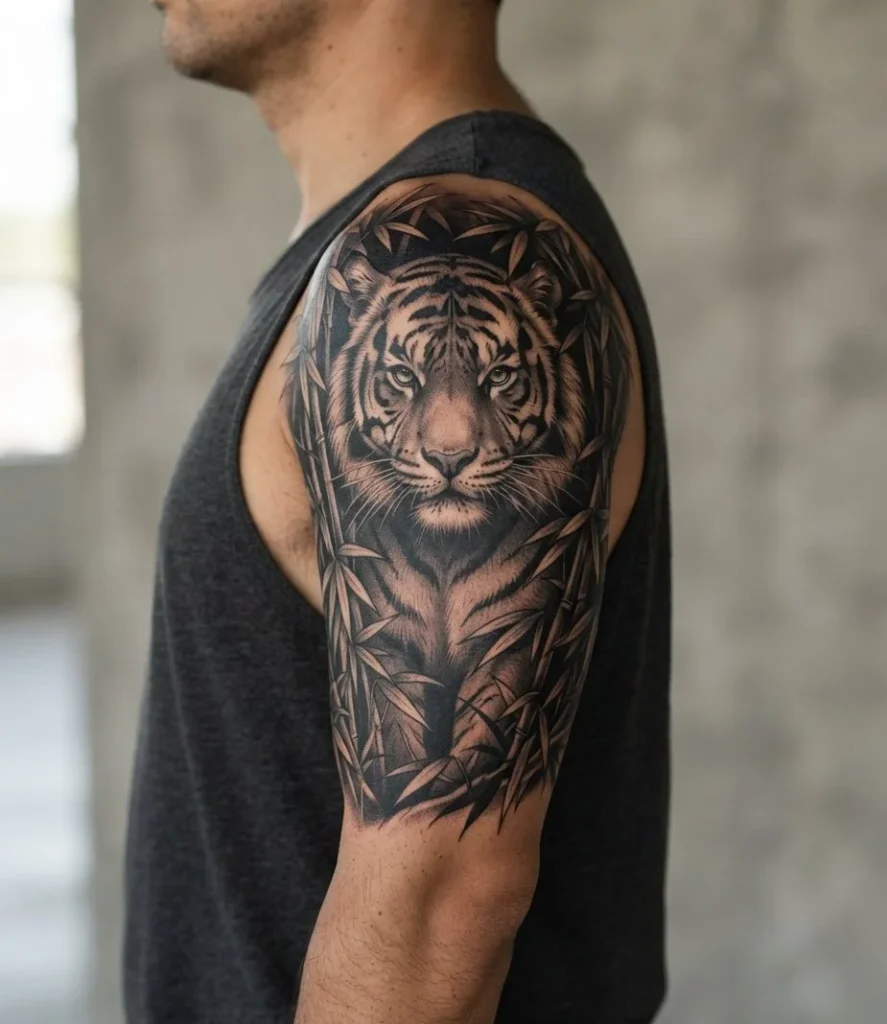
The Visual Concept: A tiger rendered mostly through negative space, its stripes left as bare skin against dense, dark bamboo foliage surrounding it.
Anatomical Flow & Coverage: The tiger’s face and shoulders center on the deltoid, bamboo filling out toward the bicep and framing the negative space stripes.
Pain & Aging Reality: A heavy, dense blackwork piece, expect a longer total session count. The negative space stripes need to stay wide and clean, since narrow negative space is the first thing to close up as ink drifts.
Why It Blows Up on Social: The high-contrast, almost glowing effect of the negative space stripes against solid black foliage is one of the most dramatic looks a sleeve can achieve.
12. The Bioluminescent Deep-Sea Jellyfish
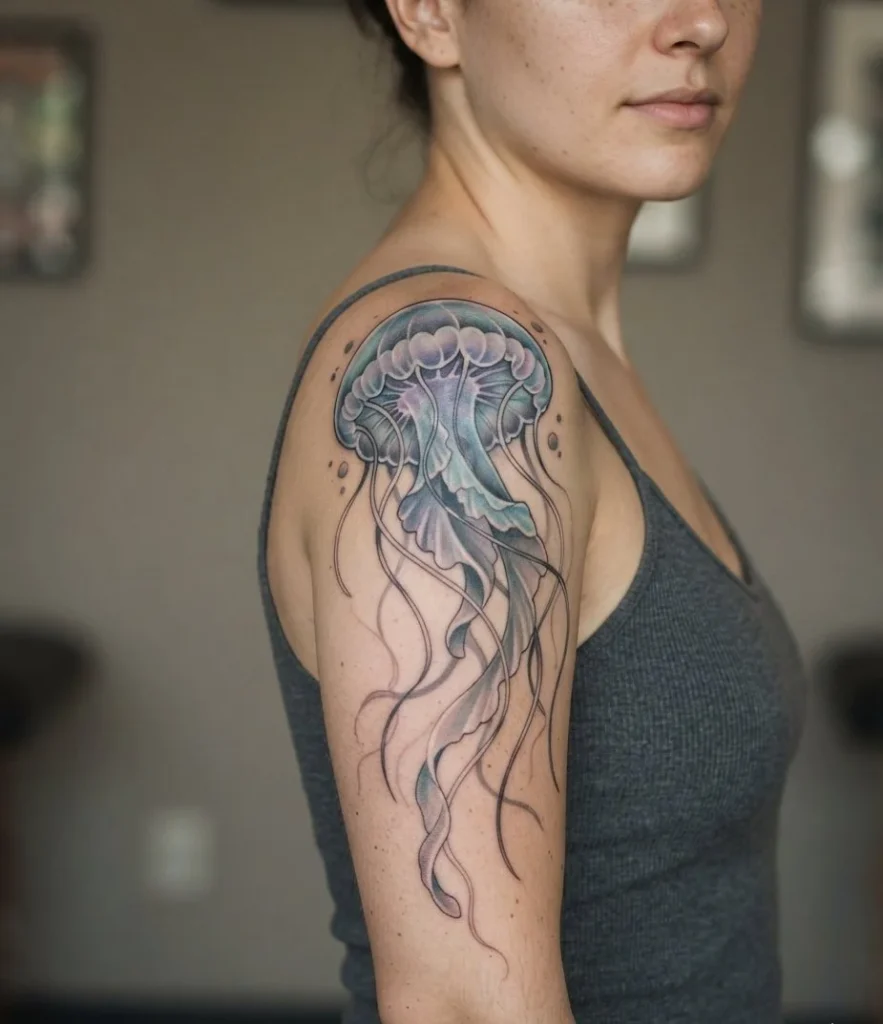
The Visual Concept: A jellyfish with a translucent, glowing bell in soft blues and purples, trailing tentacles that drift down and around the arm.
Anatomical Flow & Coverage: The bell sits directly on the deltoid cap, tentacles trailing down the bicep in an irregular, natural drift rather than a rigid, symmetrical pattern.
Pain & Aging Reality: The soft glow shading needs a slightly larger canvas to avoid flattening into a grey smudge. Asymmetric, varied tentacles age better than uniform, mirrored ones.
Why It Blows Up on Social: It brings genuine color and glow to a sleeve style dominated by black and grey, which makes it stand out immediately in a feed.
The Studio Survival Guide: Planning Your Shoulder Sleeve
The Neutral Standing Stencil Rule: Never let an artist finalize your shoulder stencil while you’re slouched back in a reclined chair. Stand up straight, arms relaxed at your sides, and check the design from every angle before a single line goes in. A stencil that looks centered while you’re sitting can shift dramatically off-axis the moment you’re standing in your actual daily posture.
Gym & Muscle Growth Myth: A lot of people worry that building serious shoulder or bicep mass will stretch their sleeve beyond recognition. In reality, moderate muscle growth has surprisingly little effect on a well-placed design, skin adapts gradually. What actually distorts a tattoo over time is significant, rapid weight change, not steady gym progress.
Pain Heatmap & Session Pacing: The outer shoulder and upper bicep are the most tolerable zones on this entire list. The inner arm, especially near the armpit and the elbow ditch, is considerably more sensitive and genuinely harder to heal cleanly due to constant movement and friction. Plan multi-hour sessions around that reality, and expect the inner-arm section to need extra aftercare attention regardless of which design you choose.
Frequently Asked Questions
Does a shoulder sleeve tattoo stretch out if I build shoulder muscle at the gym?
Not meaningfully with steady, gradual muscle growth, skin adapts along with it. Significant, rapid weight change is far more likely to distort a design than months of consistent training.
How many sessions does a complete half-sleeve tattoo typically take?
Most half sleeves take three to five sessions depending on detail level and color work, each running two to four hours. Highly detailed realism or dense blackwork pieces can push that number higher.
What is the most painful spot when getting a shoulder sleeve done?
The inner arm near the armpit and the area right above the elbow ditch are consistently the most sensitive spots on this list. The outer shoulder and upper bicep are noticeably more tolerable by comparison.